I’m going to bare my soul in this post, so be prepared.
I love writing. I love it, almost everything about it. Except for one thing: TYPOS
And by that, I mean finding typographical errors in your own work AFTER it’s been published. As an indie author, this has been my worst lesson ever. Typos happen. Typos happen. And the reason I’m repeating that with emphasis is because I’m a perfectionist by nature and have had to learn how to live with myself because they do happen.
Ways to live with yourself if you find typos in your work.
1. Understand the human brain.
Our brains read words as a whole and often skip over typos within a sentence as the mind fills in what it’s “supposed” to read. For example, try reading this:
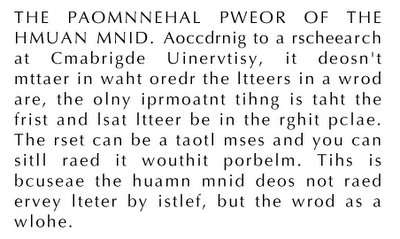
Could you understand it? I suppose it’s sort of nice of our brains to compensate for errors/typos like this when we’re reading, but it’s really quite horrible for editing and revising. As a writer, I have the most terrible time finding typos in my own work. Give me someone else’s work and if asked, I can proofread it and find typos like a champ. But if someone holds up a page and points to a typo in a sentence that I wrote, I will stare at it for an eternity without ever seeing the typo unless they explain what I’m supposed to be seeing. All because of my brain filling in what it already “knows” is supposed to be there. Thanks a lot, brain… Okay, moving on.
2. Remember that you’re only human. And that you’re in good company. (Typos happen, remember?)
Okay, so we have brains. And we’re only human. Here are some fun examples of typos that are undoubtedly excruciating to think about for the authors in question. The first three have become “famous typos” because of their humorous nature.
The Pasta Bible by Silvio Rizzi and Tan Lee Leng, 2010
Recipe calls for “ground black people.” (corrected to “ground black pepper” but not until 7,000 copies had been printed and distributed)
King James Bible, 1631
“Thou shalt commit adultery.”(hereafter known as the “Wicked Bible” or “Sinner’s Bible” edition)
Baby I’m Yours by Susan Anderson, iBook version, 2011
“He stiffened for a moment but then she felt his muscles loosen as he sh*tted on the ground.” (corrected to “shifted on the ground,” but not until many people had already purchased it from iTunes).
MY OWN NOVEL: Mythology by Helen Boswell, 2012
3. Most readers will read for the read
Because of the way the brain works, this is true MOST of the time. The free ARCs (Advance Reader Copies) that I gave to reviewers had typos, and when I shipped them out, I explained in most humble and shamed tones that there would be typos in them. Some of my reviewers caught them. But some of them told me that they didn’t see any of them! Either way, most reviewers/readers will focus on the story. But there are those who will examine every single word and may comment on editorial errors in their review.
Confession time: I have a short list of other typos that made it into my book. A LIST. MORE. THAN. ONE. TYPO. And I’ve just recently done what any perfectionist would do. I stared at the list and beat my head against the wall. I cried for an hour. But then I went back to my original files and fixed all of them, paid a terribly expensive fee to my ebook editor to fix all of the typos in the ebook files, and I resubmitted my print files to CreateSpace. I could have left them in there but decided that it would be better in the long run to kill those typos, KILL THEM DEAD, before they tormented me for my entire life.
Unfortunately, I didn’t catch/fix all of the typos before I did a huge free promo at the beginning of the month and >1,000 copies of my book got downloaded. *sighs* So if you have a copy of my book, you MAY have an edition with typos. Hang onto it because they will soon be out of circulation and worth millions relative to the corrected edition out there (slight very large exaggeration).
So, advice to all authors: Please don’t kill yourself over typos. Please don’t beat your head on the wall or lose sleep over them like I’ve done. But of course, you should take the greatest efforts to try to eradicate them before they multiply while you’re asleep (they kind of have a way of doing that). Don’t fool yourself into thinking that “spellcheck” is omniscient. Read your book out loud. Get an editor to help. I did all of these things, but in the end, it was my mother-in-law who gave me the list of typos that she caught. Because mother-in-laws are good at coming over and finding all of the dust that you didn’t see in your house before you invited guests over. No, seriously, she found them because she is one of my biggest fans, bought both print and Kindle editions of my book, and has read both versions probably 10 times. And because she happens to have a background in proofing legal briefs. I think I might hire her as my editor next time. Just to look for typos.
 Thinking Through Our Fingers